

A proposal to give every AFL centre bounce real height and hang time, with no umpire in the contest.
An independent proposal · September 2026

This video didn’t load.
Fig. 1 The backyard prototype. Real footage, September 2026.
1A spectacular start
A spectacular start.
The old centre bounce could be spectacular. In the 1993 and 2002 Grand Finals the ball soared high, straight and true, and the occasion was set from the first second.

This video didn’t load.
Hang time 2.47 s

This video didn’t load.
Hang time ≈1.35 s

This video didn’t load.
Hang time 0.60 s
But bounces like these were never guaranteed. Too often the ball went sideways, fell short or never delivered. And the new centre ball-up simply isn’t in the same league.
The Centre Bounce Machine delivers that height and accuracy every time. No unpredictable bounce. No ball going sideways. No umpire in the way. Add dramatic lighting, sound and even smoke, and the opening bounce becomes more than the start of a game. It becomes a television event.
2Umpire safety
Umpires out of the contest.
The Centre Bounce Machine takes umpires out of the immediate contest. They don’t have to back away and will no longer become targets for players pushing and manoeuvring for the best position. Umpire safety is immediately enhanced.


3Formula 1 red‑light start
Formula 1 red‑light start.
What makes a Formula 1 start so compelling is that nobody knows exactly when it will happen.

The red lights build the tension. Spectators know the race is almost ready, but not the moment the lights will go out. The final hold is deliberately unpredictable, a random delay of around 1 to 5 seconds, and that small uncertainty creates anticipation, excitement and theatre.
Bringing the same excitement to the AFL
With an umpire-controlled ball-up, spectators watch the umpire prepare and know exactly when it’s coming. The anticipation is lost. The Centre Bounce Machine changes that: a randomised start sequence signals the bounce is imminent, then holds for a random 1 to 5 seconds before release. Just like Formula 1, everyone knows it’s about to happen, but not exactly when. That uncertainty turns every centre bounce into a moment of theatre.
A launcher flush with the turf fires the ball high and straight over the rucks at every centre bounce.
4How it works
Charge. Set. Release. Reset.
A pneumatic launcher sits flush under the turf at the centre spot. The umpire starts it from outside the square.
1Charge
The onboard pressure tank is charged with compressed air. In testing it ran at 6–8 bar.

 PistonAngle-seat valveFlush capPressure tank
2Set
The ball sits on a seat flush with the turf. Height-adjustment bolts set the plate level with the surface.
PistonAngle-seat valveFlush capPressure tank3Release
After the start sequence it holds for a random 1–5 seconds. Then a valve dumps the air through the flange connector into the piston, which snaps up and fires the ball vertically.
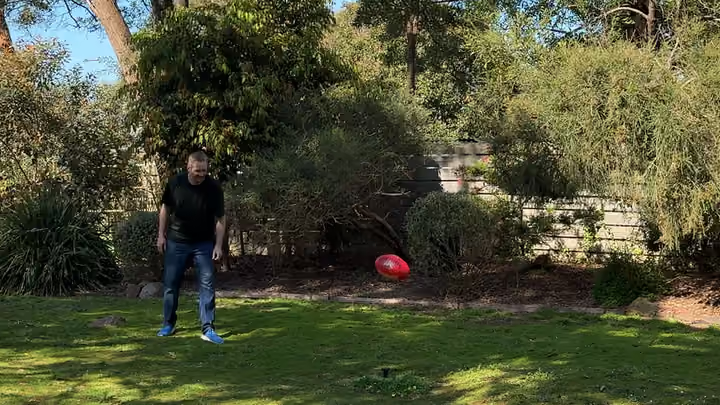
The real lever, backyard prototype. PistonAngle-seat valveFlush capPressure tank4Reset
The piston retracts and the cap sits flush again, ready for the next goal.
PistonAngle-seat valveFlush capPressure tank
- Drive
- Pneumatic
- Tested at
- 6–8 bar
- Mount
- Flush with the turf
- Release
- Random 1–5 s hold
Read the proposalThis isn’t about reversing the AFL’s move to modernise the centre restart. It’s about improving the replacement.